
CloudOps, Explained: Why your startup can’t scale without it
Learn how CloudOps helps startups cut costs by 40%, automate growth, and scale fast. Your complete guide to cloud operations in 2025.

Your startup just landed its first major client. Traffic is surging. Your app is struggling to keep up under the load. Your AWS bill just tripled overnight, and nobody knows why. Sound familiar?
This is the moment when most founders realise they need CloudOps, often too late, and always at a high cost. CloudOps is the strategy that turns cloud chaos into scalable, predictable growth.
What is CloudOps, really?
CloudOps (Cloud Operations) is the discipline of managing, optimising, and securing cloud infrastructure at scale. Think of it as DevOps built for the cloud, combining automation, monitoring, cost control, and security into one operational framework.
But in 2025, CloudOps isn’t just about keeping systems running. It’s about enabling your startup to move fast without breaking things or the bank.
The startup CloudOps paradox
Startups face a unique challenge: you need enterprise-grade infrastructure to compete, but not the enterprise team or budget. You need to scale rapidly, yet your cloud costs can spike faster than your revenue.
Properly managed cloud computing can cut startup costs by 30–40% compared to traditional infrastructure. But without CloudOps, companies routinely waste 30% or more of their spend on unused resources, oversized instances, and inefficient architectures.
The six pillars that make or break your scale
1. Automation: your competitive advantage
The problem: Manual provisioning drains time and consistency.
The solution: CloudOps automation ensures speed, stability, and repeatability.
Key practices include:
- Infrastructure as Code (IaC) using Terraform or CloudFormation
- Auto-scaling that responds to demand instantly
- Self-healing systems that detect and resolve issues before users notice
Startups that automate CloudOps tasks see 60% faster deployments and 50% fewer incidents.
2. Monitoring & Analytics: know before your customers do
You can’t optimise what you can’t measure.
Real-time visibility with CloudWatch, Google Cloud Operations, or Datadog gives you:
- Performance and utilisation dashboards
- Proactive alerts before outages
- Data-driven insights for scaling and optimisation
Example: One TardiTech client reduced downtime by 40% simply by setting smarter alert thresholds.
3. FinOps: the new competitive battleground
According to the FinOps Foundation (external link), it merges financial accountability into CloudOps, so engineers can see, manage, and prevent waste in real time.
Core FinOps practices:
- Real-time cost monitoring to detect anomalies instantly
- Rightsizing resources to match demand
- Automated budget guardrails that block expensive misconfigurations
- Unit economics tracking to understand the cost per customer
Forward-thinking startups embed cost awareness into development, using sandbox budget caps and automated spending limits.
(Related read: The Hidden Costs of Broken DevOps and How Startups Can Fix Them)
4. Security & Compliance: non-negotiable from day one
Security breaches kill startups. Period. CloudOps makes security continuous and automated, not an afterthought. Following frameworks like the AWS Well-Architected Security Pillar (external link) ensures comprehensive protection.
Essential practices:
- Encryption at rest and in transit
- Least-privilege IAM policies with routine audits
- Automated vulnerability scanning in CI/CD
- Regular patching and compliance validation
Your first enterprise client will ask about your security posture. CloudOps ensures you have an answer.
5. CI/CD Integration: ship faster, break less
Modern CloudOps extends CI/CD beyond code. It automates infrastructure and configuration testing, too.
Best practices:
- Automated testing of infra changes pre-deploy
- Canary deployments to minimise blast radius
- Rollbacks that restore service in minutes
This is how teams achieve true continuous delivery without chaos.
6. Disaster Recovery: hope is not a strategy
Most startups don’t plan for failure until it happens. CloudOps builds resilience in from the start.
A solid DR plan includes:
- Automated backups with restore testing
- Multi-region failover capability
- Documented runbooks for key failure scenarios
- Clearly defined RTO/RPO targets aligned with business impact
Resilience isn’t a luxury. It’s your uptime insurance.
The CloudOps tech stack for 2025
| Category | Tools | Purpose |
|---|---|---|
| Provisioning / IaC |
|
Terraform, AWS CloudFormation, Pulumi
|
Consistent, automated infrastructure setup
| |
Config Management
|
Ansible, Chef, Puppet
|
Automate server configurations
| |
Monitoring & Observability
|
Datadog, CloudWatch, Grafana, New Relic
|
Track performance and detect anomalies
| |
Cost Management (FinOps)
|
AWS Cost Explorer, CloudHealth, CloudKeeper
|
Monitor and optimize cloud spend
| |
Security
|
GuardDuty, Snyk, Aqua, Vault
|
Secure workloads and secrets
| |
Incident Management
|
PagerDuty, OpsGenie
|
Intelligent alerting and response
|
Tip: Start with native tools (such as AWS CloudWatch) and evolve toward specialised observability and FinOps platforms as your scale increases.
Emerging Trends: what’s next for CloudOps
- **Sustainability as strategy:**CloudOps teams now optimise for carbon and cost. Cloud providers like AWS are surfacing sustainability metrics directly in dashboards.
- **AI-Powered operations:**Machine learning agents are starting to auto-tune cloud resources and detect anomalies before humans can.
- **Proactive over reactive:**The best teams automate prevention, not just response, embedding guardrails early to eliminate costly mistakes.
- Multi-cloud and supercloud: Platforms like Anthos and Azure Arc enable startups to stay flexible across providers, reducing vendor lock-in risks.
The ROI that matters
When done right, CloudOps delivers tangible results:
- 70% less manual ops work
- 40% lower infrastructure costs
- 50% faster incident resolution
- 3× more frequent deployments
- 99.9%+ uptime, fueling customer trust
But the true ROI? Your engineers get back to doing what actually grows your startup, building features your customers love.
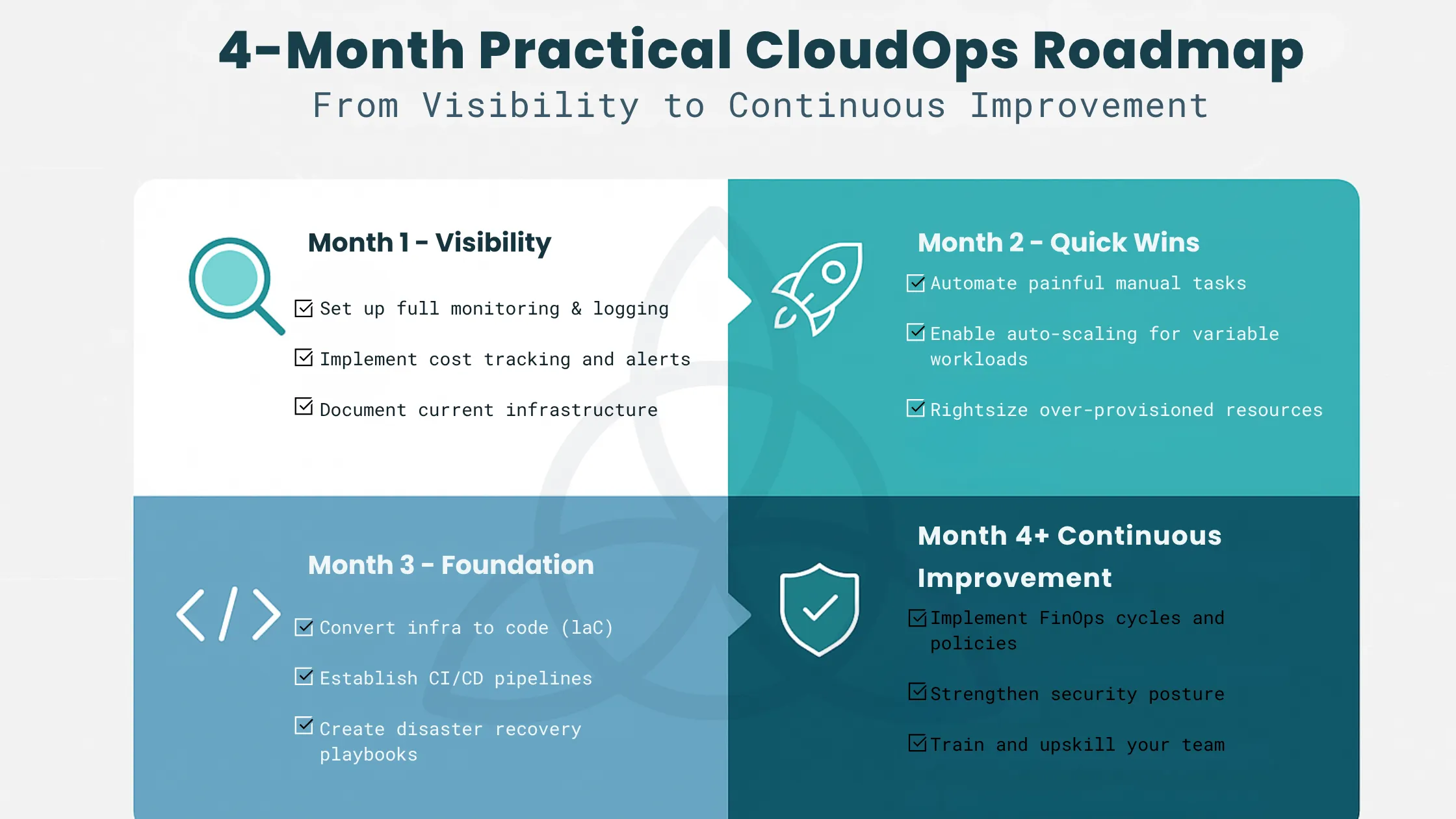
Here’s your step-by-step roadmap to build resilient, cost-efficient CloudOps foundations from visibility to continuous improvement.
The bottom line
CloudOps isn’t a luxury for large enterprises anymore. It’s the foundation of sustainable scale for modern startups.
Your competitors are already automating, optimising, and securing their cloud operations. The question isn’t whether you can afford CloudOps. It’s whether you can afford not to.
Startups that win in 2025 won’t just have great ideas. They’ll have the ability to execute, iterate, and scale faster than anyone else. CloudOps is how you get there.
Ready to transform your cloud operations?
Start small. Automate relentlessly. Every manual task you eliminate today is one less thing slowing your growth tomorrow.